
In the horticulture industry, the focus is increasingly shifting from generating energy to managing energy. It is no longer about how much capacity you install, but about how growers deal with peaks and fluctuations in energy demand and supply.
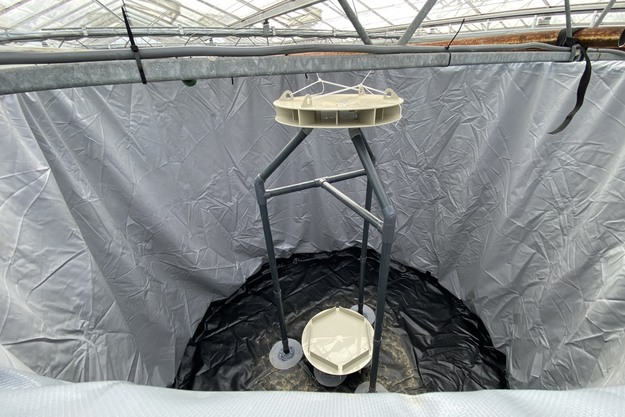
For Genap this was the reason several years ago to start developing insulated cold and heat storage systems for water. Water storage is therefore gaining an additional function: not only as a supply for irrigation, for example, but also as part of the greenhouse climate system.
This development aligns with questions coming from the market. Harvest House, together with CombiCoop, worked on the tomato greenhouse of the future, aiming to significantly reduce fossil-based heating and CO₂ consumption within an existing greenhouse. “Current greenhouses are already highly efficient,” says Arjan Flikweert of CombiCoop. “So the real question was: what can we improve without having to start all over again?”
© Genap
The answer lies in keeping the greenhouse as closed as possible. This helps retain both CO₂ and heat, but it also causes humidity levels to rise too much. Active dehumidification requires cooling, but not always at the same moment. “When a plant is transpiring heavily, you naturally need more cooling than when the plant is at rest,” explains Flikweert. “If you respond to that directly, you end up with a system that is constantly switching on and off.”
That is exactly why buffering makes sense. Cold storage creates room to better balance supply and demand. The solution was found in Genap’s insulated silos. As a result, the heat pump no longer has to continuously switch on and off, but can operate for longer periods at a stable and constant capacity.
 © Genap
The system has now completed its first winter and spring season. “It works,” says Flikweert. “We clearly see lower gas and CO₂ consumption. At the same time, it is also clear that the system is still evolving.” Further developments are focusing on making even smarter use of outside air, as well as the next step in storage. “That heat pump also generates heat,” says Flikweert. “We currently use part of that heat directly. But if you want to use heat just as flexibly as cooling, you need to be able to store it. That could very well be the next step.”
The project shows that the biggest gains are not found in adding more technology, but in using technology more intelligently. By storing energy and using it at the right moment, a system becomes easier to control and less dependent on peak loads.
For more information:
Genap B.V.
[email protected]
https://genap.com/
Trending Products

Benchmark Bouquets – Flowerin...

Perfectione Roses Preserved Flowers...

Sen Flora Preserved Flowers Bouquet...

CKLMMCZX Preserved Flowers Bouquet ...

KaBloom The Romantic Classic Red Ro...

lovenfold Flowers for Delivery Prim...

Stargazer Barn – Holiday Chee...

Benchmark Bouquets – Signatur...

Bloom’s Diary Preserved Flowe...
