
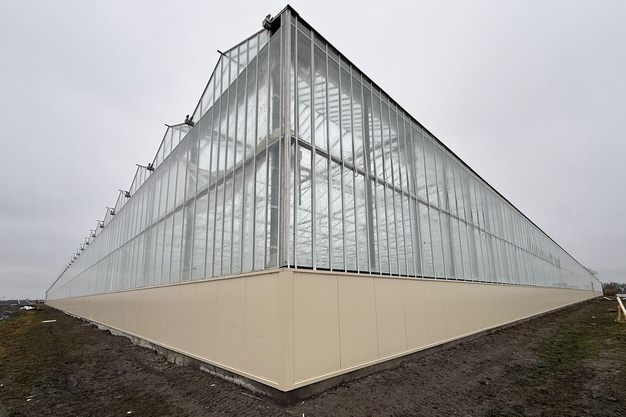
It’s hot in Europe, and the little town of Tadten in Austria is no exception. Yet, Lukas Sattler of local greenhouse Gartenbau Sattler reports stable crop performance. “The plants are stronger than last year, and it’s easier to control the climate in the greenhouse,” he says. This follows the lifting of the 4.8-hectare greenhouse by 1.7 metres during the past winter, carried out by TC van den Dool.
“The weather conditions might still be extreme, but we can overcome the challenges,” Lukas says. “Before the lifting, at this time of year, the plant heads were only about 50 centimetres from the roof. Now they are about 1.2 metres away from it. Inside the greenhouse, the temperature is around 28 degrees, compared to 34 degrees last year.”
The greenhouse structure was raised from 4.5 metres to 6.2 metres. Quite a job, but replacing the entire greenhouse was not an option for the company, nor a preferred choice. And not just because the costs are much higher. “The roof was good, I didn’t have any problems with the roof,” Lukas says. “Plus, rebuilding would have been a more complicated process involving more regulations and would have taken us out of production for a year.”
© TC van den Dool
Retail partnerships
Gartenbau Sattler grows cherry tomatoes for various Zeiler brands, such as Sunstream Alon, Vitalion and Prodelle. Distinguishing themselves through a focus on local production, taste, and sustainable cultivation, demand for these tomatoes has grown steadily over the years, and retail partnerships are of high importance. This is also why shutting down production for a year was not an option: demand for their produce has grown steadily, and production is planned accordingly.
Instead of rebuilding, the greenhouse was lifted by TC van den Dool. “By raising the structure, the existing roof could remain in place and the grower avoided the longer downtime that comes with a complete rebuild,” says owner Vincent van den Dool. He adds the lifting process itself is standard work for the company since they specialised in it for many years. “The challenge was the timing, and mainly doing it fast. You want the grower back into production as soon as possible, and ensure all work is done neatly.” And they managed to: the greenhouse was raised and closed again within seven weeks. “It’s always nice when everybody is working towards the same goal. We really collaborated with the Sattler team. In projects of this size, you always stumble on something unexpected, and we were happy to solve it together to get the job done.”
Tecnical upgrades
Following completion of the work in winter, planting resumed in week five, approximately three weeks later than the normal schedule. Additional technical upgrades include the installation of a high-pressure fogging system and the renewal of vertical ventilation units. Climate settings required only limited adjustments after the reconstruction. “We ran very low temperatures following planting, and it went very well. It was easy to maintain humidity and steer the plant sufficiently generative at the beginning,” Lukas says.
These systems provide additional control options during high temperature periods. “Without the high-pressure mist system, the temperature inside the greenhouse would be around three degrees higher than the outside temperature,” Lukas says. “With the high-pressure mist system and the raised greenhouse, we can keep the inside temperature nearly the same as the outside temperature. Later in the day, the temperature inside the greenhouse is even lower than outside.”
 © TC van den Dool
Challenging nighttime conditions
Yet, in extreme weather like the one currently gripping Europe, nighttime conditions remain challenging. “The high temperature during the day is not always the problem, it’s the extended duration of high night temperatures,” Lukas says. “We don’t have nighttime temperatures below 20 degrees for extended periods in summer, which makes these conditions challenging.” Fortunately, the plants are much stronger than they were last year. “It’s still to early to compare production with previous years, as our season started three weeks later after the greenhouse raising was completed, but we see the crop is stronger, and handles the warm nights much better.”
Compared to the previous season, crop management during warm periods requires fewer interventions. A second screen is being considered, but installation is linked to electrical upgrades. For now, the system continues with a single screen. “Last year we had to close the screen at some points,” Lukas says. “This year, I’m trying not to do it so that we can make the most of the incoming light. And so far, we seem to be doing well.”
For more information:
T.C. v.d. Dool B.V.
Aartsdijkweg 55
2676 LE Maasdijk
+31 (0)174 513094
[email protected]
www.tcvddool.nl
Trending Products

Benchmark Bouquets – Flowerin...

Perfectione Roses Preserved Flowers...

Sen Flora Preserved Flowers Bouquet...

CKLMMCZX Preserved Flowers Bouquet ...

KaBloom The Romantic Classic Red Ro...
lovenfold Flowers for Delivery Prim...

Stargazer Barn – Holiday Chee...

Benchmark Bouquets – Signatur...

Bloom’s Diary Preserved Flowe...
