
“In Northern European horticulture, glass has long been the default covering material for production greenhouses for a simple reason: laboratory measurements show it transmitting approximately 91% of the visible light, whereas a conventional double-layer polyethylene PE system transmits only 75-76%. This difference has reinforced the widespread perception that plastic coverings inevitably result in lower light transmission,” says Nicolas Julien, Filclair. He argues that laboratory measurements do not fully reflect greenhouse conditions, where condensation, diffuse winter light and structural shading affect the amount of usable light reaching the crop. “When double-layer ETFE with a no-drop surface treatment is evaluated on commercial greenhouse roofs over multiple years, accounting for condensation, the spectral and angular distribution of northern winter light, and the structural characteristics enabled by a lightweight covering material, the results tell a different story.” He says double-layer ETFE greenhouse coverings can match or exceed the light transmission of glass under commercial growing conditions while reducing heat losses
According to Nicolas, field studies show that ETFE performs at least as well as conventional glass under production conditions. In a review, he examines research from Wageningen University & Research (WUR), CTIFL, TNO and other institutions on greenhouse covering materials. It focuses on two areas that influence greenhouse performance: light transmission and energy consumption.
“Across a range of field studies, double-layer ETFE performs at least as well as conventional glass and, in direct greenhouse comparisons, often performs measurably better. Moreover, ETFE-compatible flat-arch structures provide an additional light-transmission advantage that conventional glass constructions cannot achieve, regardless of the optical performance of the covering material itself.”
Click here for the complete study.
© FilClair
Efficiency
A five-year study led by Hans-Jürgen Tantau in Germany found that double-layer ETFE systems were “as efficient as conventional glazing materials” in terms of PAR transmission under field conditions. A separate CTIFL project in southern France compared a double-wall ETFE greenhouse with an identical glass Venlo greenhouse and measured 6-8% higher light transmission in the ETFE structure, with an average winter advantage of 5%.
“The review points to condensation as one reason for the difference. Research by Pollet and Pieters showed that condensation droplets on glass can reduce PAR transmission, while anti-drop surfaces create a water film that avoids those losses”, Nicolas shares.
Structural design
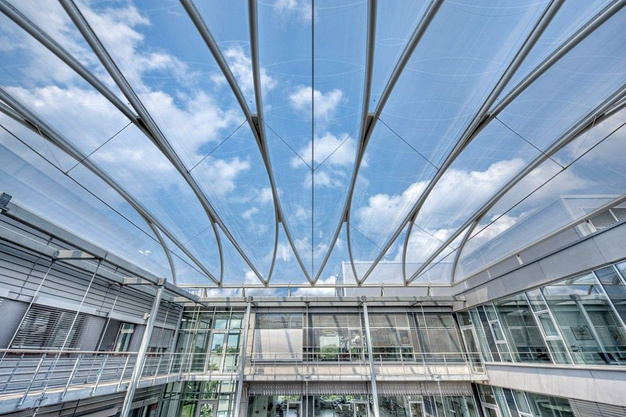
Structural design also influences light transmission. According to Nicolas, the lighter weight of ETFE allows the use of flat-arch greenhouse structures, which allocate 5-7% of roof area to structural elements compared with around 11% in a Venlo greenhouse. “This translates into 4-6 percentage points of additional transparent roof area.”
He also dove into research on diffuse light. Studies at WUR found that diffuse greenhouse coverings can improve light distribution through the crop canopy and increase tomato yields. In the CTIFL comparison, researchers reported tomato yields 5-10% higher in the ETFE greenhouse than in the glass reference greenhouse.
 © FilClair
Warranties
ETFE film substrates are covered by optical warranties exceeding 20 years, while anti-drop surface treatments carry separate warranties of three to seven years. Nicolas notes that the studies on anti-drop performance predate current film generations and should therefore be viewed as a conservative baseline for today’s coatings. He also points to the ETFE covering installed on CTIFL’s experimental greenhouse at Balandran in 2009, which remains in place.
Energy use
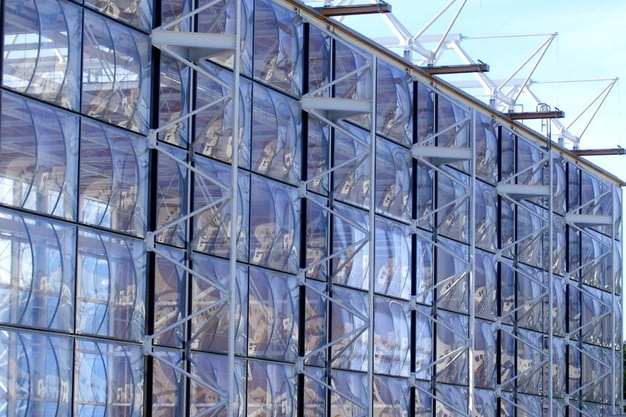
Alongside light transmission, energy use is a central part of the analysis, and the current greenhouse industry. Measurements carried out by TNO showed a U-value of 4.0 W/m²K for double-layer ETFE compared with 5.3 W/m²K for 4 mm float glass. The insulation comes from the air layer between the two films. “Energy simulations conducted with Hortinergy indicated that double-wall film greenhouses can reduce annual heating demand compared with a glass Venlo greenhouse”, Nicolas says, referencing a technical sheet validated by ADEME and ATEE in 2023 that cites energy savings of around 30% for double-wall plastic greenhouse structures.
“In practical terms: at typical Dutch heated vegetable greenhouse consumption of around 340 kWh/m²/year (CBS Statline, 2023)¹⁴, a 28–30% reduction saves 95–100 kWh/m²/year. For a 7-hectare project at current Northern European gas prices, that exceeds €200,000 per year — a margin that rising gas costs only widen.”
 © FilClair
Energy consumption and commercial context
Nicolas notices that the discussion around ETFE has changed as greenhouse operators place greater emphasis on energy consumption. “The commercial context has changed. The era of cheap gas that made insulation optional is over. Now we’re at the completion of engineering work that makes ETFE compatible with production-scale flat-arch systems; and see the emergence of Chinese ETFE film manufacturers that have introduced genuine price competition in a previously closed market.”
“The combination that once seemed reserved for showcase projects — ETFE performance at a viable commercial price — is now accessible.” He adds Filclair has largely addressed the technical barriers.”The structure is validated. The thermal and light performance data is published and peer-reviewed. The supply chain is in place. The question that remains, is a commercial one.”
Click here for the complete study.
For more information:
Nicolas Julien
Filclair
Tel.: +31 623 141 992
Email: [email protected]
[email protected]
www.filclair.com
Trending Products

Benchmark Bouquets – Flowerin...

Perfectione Roses Preserved Flowers...

Sen Flora Preserved Flowers Bouquet...

CKLMMCZX Preserved Flowers Bouquet ...

KaBloom The Romantic Classic Red Ro...
lovenfold Flowers for Delivery Prim...

Stargazer Barn – Holiday Chee...

Benchmark Bouquets – Signatur...

Bloom’s Diary Preserved Flowe...
