
Greenhouse growers and other ornamental producers in North America continue to report sales growth during the first half of 2026, although the pace of growth has slowed compared to previous years. At the same time, higher input costs, inflation, trade uncertainty and a slower housing market continue to influence business decisions. These were among the observations shared by Dr. Charlie Hall, Chief Economist at AmericanHort, during his Economic Update keynote at Cultivate 2026.
Presenting his annual market update, Charlie described the current market as one that has stabilized after the rapid expansion during the pandemic years. “We’re definitely moving sideways. We’ve plateaued and we’re maintaining that plateau.”
© Martijn Haas | FloralDaily.com
Sales continue to grow, but at a slower pace
Data collected through Charlie’s Green Industry MarketMetrics benchmarking program show that 81% of growers report higher gross sales during January through June 2026 compared to the same period last year, while 20% report lower sales. Most of the increase is modest, with the largest group of respondents reporting growth between 0% and 5%.
Looking beyond year-over-year comparisons, Charlie notes that 98% of growers remain ahead of their 2019 sales levels, indicating that much of the demand created during the pandemic remains in the market. “We had anywhere from 18 to 20 million new gardeners during that time period,” Charlie says. “Apparently we’ve captured them and they’re still engaged.”
A new five-year comparison also illustrates the slower pace of growth. In 2023, around 20% of growers report sales increases exceeding 10% year over year. In 2026, that share declines to approximately 12%, reflecting a market that continues to expand but at a more moderate rate.
Unit sales remain positive
Growth is not limited to higher selling prices. According to the survey, 68% of growers report higher unit sales, while 32% report lower volumes. Compared with 2019, nearly 80% of growers are selling more units than before the pandemic. Charlie emphasizes that separating unit sales from revenue is important because price increases implemented in recent years can mask changes in demand.
Consumer spending data support this trend. Purchases of flowers, seeds and potted plants increase sharply during the pandemic, followed by several periods of stabilization rather than returning to pre-pandemic levels. After a decline during the second half of 2025, spending increases again during the first five months of 2026.
Profitability remains mixed
Profit performance is more mixed than sales. Sixty-one percent of growers report higher net profits than a year earlier, while 41% report lower profits. Compared with 2019, about 79% remain more profitable. “I might theorize that those are growers that maybe didn’t keep up with their pricing strategy with the added input cost,” Charlie says.
Retail demand remains steady
Retail garden centers also report growth during the first half of the year. Data from The Garden Center Group show revenue increasing by 5.3% year over year. Transaction counts rise 1.7%, while the average transaction value increases 3.6%.
Large home improvement retailers also record growth in lawn and garden. Although comparable sales at Home Depot and Lowe’s increase only 0.6% overall, Charlie says lawn and garden sales at those retailers are approximately 7.5% higher than last year. Promotions funded by the retailers rather than growers also support sales.
He also points to continued growth in direct-to-consumer online sales, although they still represent a relatively small share of the market.
Consumers continue spending
Consumer confidence remains weak, but spending behavior provides a more useful indicator for the industry, and that’s more important, Charlie says. “I don’t care how we feel, I care how we spend our money.” And consumer spending on ornamental products increases 2.4% year over year, despite declining consumer sentiment. Households maintain spending by drawing down savings and increasing credit card use. The personal savings rate now stands at 3.0%, compared with 4.8% during the pandemic.
There is a growing divide between higher-income and lower-income households. Higher-income consumers continue spending, while lower-income households face more financial pressure. One trend becoming visible at retail is consumers trading down to lower-priced products rather than reducing purchases altogether.
Housing remains a limiting factor
Housing construction continues below demand, limiting opportunities for landscape installations tied to new homes. Charlie says mortgage rates remain the main constraint. “As housing goes, we go,” he says.
He expects housing demand to strengthen once mortgage rates fall below approximately 5.5%, creating additional demand for landscape plants. The remodeling market remains active, supporting landscaping activity.
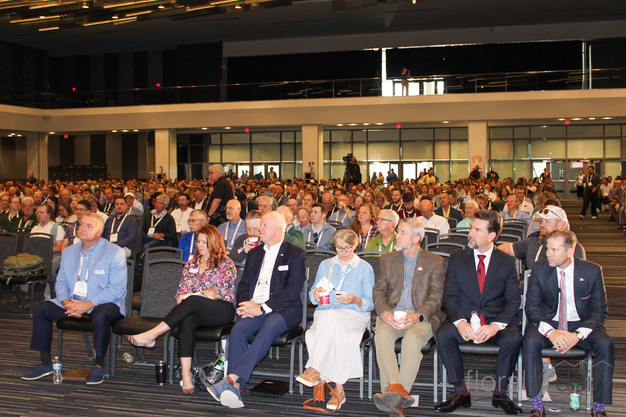 © Martijn Haas | FloralDaily.com
Input costs continue to increase
Input costs remain one of the main concerns for growers. Fuel, fertilizers and freight show the largest increases among production expenses. Charlie forecasts freight costs increasing approximately 6% over the full year, although spot market rates currently remain much hig her.
Since 2019, total input costs increase by approximately 23%. “If you have not adjusted pricing, just know that the input cost structure is not going down,” Charlie says. “Our cost structure is going to continue to go up.”
He says businesses need to offset those costs through pricing strategies or operational efficiencies, including automation, mechanization and artificial intelligence.
Trade policy continues to create uncertainty
Trade policy remains another source of uncertainty. Charlie highlights ongoing discussions around Section 301 tariffs and points to developments around the Strait of Hormuz as a potential risk for global supply chains and transportation costs. Depending on how these issues develop, input costs in 2027 could increase between 2.5% and more than 5%.
Despite these uncertainties, Charlie’s recession model currently estimates the probability of a U.S. recession at approximately 16%, similar to estimates from the Federal Reserve Bank of New York.
 © Martijn Haas | FloralDaily.com
Focus shifts to efficiency
With growth slowing and costs continuing to increase, Charlie says growers need to focus on operational efficiency, working capital management and product mix decisions. “We’ve got to sharpen the pencil,” he says. “We have to find those operational efficiencies and manage our cost structure.”
Trending Products

Benchmark Bouquets – Flowerin...

Perfectione Roses Preserved Flowers...

Sen Flora Preserved Flowers Bouquet...

CKLMMCZX Preserved Flowers Bouquet ...

KaBloom The Romantic Classic Red Ro...

lovenfold Flowers for Delivery Prim...

Stargazer Barn – Holiday Chee...

Benchmark Bouquets – Signatur...

Bloom’s Diary Preserved Flowe...
