
August 19 marks the Qixi Festival, China’s traditional Valentine’s Day, and one of the most important flower consumption periods of the year. During this year’s Qixi season, wholesalers generally reported that flower price increases were less pronounced than in previous years, while consumer preferences for personalized choices became more evident.
In terms of flower varieties, red roses continued to dominate the market. Among them, the “Plateau Red” rose stood out as the top choice, favored for its long vase life and rich, vibrant color. Meanwhile, varieties such as the pale yellow “Cream Cup” and the light purple “Nightingale” also saw moderate price increases, though overall price fluctuations remained limited. In terms of bouquet packaging, materials like lace flowers and satin ribbons were widely used, adding a touch of refinement and fashion appeal to floral arrangements.
Compared with previous years, the most notable shift this year lies in changing consumer attitudes: a growing number of women are buying flowers for themselves, rather than waiting for others to give them flowers. “Flowers are beautiful, and I can buy them for myself. They make me happy.” — this has become a genuine sentiment among many women, reflecting the rise of the “self-pleasure” consumption concept.
© Luo (Cathy) Rong | FloralDaily.com
On the distribution front, the rapid development of e-commerce platforms and cold-chain logistics is reshaping the traditional model in which florists sourced their products from wholesale markets. In the past, a bouquet typically passed through multiple intermediary layers — from growers to primary wholesalers, secondary wholesalers, and then to florists — before reaching the consumer. Today, growers can directly reach end consumers through e-commerce channels, significantly reducing intermediate links. This not only lowers flower prices but also attracts more price-sensitive consumers.
However, e-commerce channels also face notable challenges. Due to inconsistent temperature control and logistics conditions during transportation, flower quality remains uneven. Issues such as damaged flower heads and broken stems are common, making quality assurance a key pain point for the online flower retail model.
According to data released by the China Flower Association in April this year, China’s flower retail market reached a total value of 249 billion yuan in 2025, representing a year-on-year increase of approximately 13.18%. E-commerce channels accounted for 137.4 billion yuan, or 55.2% of the total, while physical flower shops generated 111.6 billion yuan, accounting for 44.8%. E-commerce has now become the primary channel for flower retail, and the industry’s transformation continues to accelerate.
Trending Products

Benchmark Bouquets – Flowerin...

Perfectione Roses Preserved Flowers...

Sen Flora Preserved Flowers Bouquet...

CKLMMCZX Preserved Flowers Bouquet ...

KaBloom The Romantic Classic Red Ro...
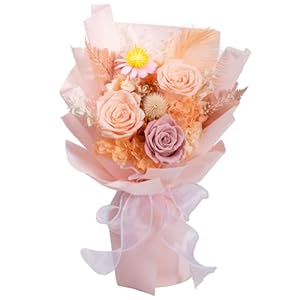
lovenfold Flowers for Delivery Prim...

Stargazer Barn – Holiday Chee...

Benchmark Bouquets – Signatur...

Bloom’s Diary Preserved Flowe...
