
Which water quality levels pose risks to plants? That was a question in a Dutch research project. Researchers investigated how smart sensors could support a digital warning and decision-support system for this. As a result, Sendot’s Water Quality Unit was born. Vreugdenhil Young Plants has already experience with the system.
Sendot specializes in water quality with a water quality management system with real-time monitoring and alerting. This significantly simplifies water quality management. As a result, time is saved while water quality is continuously monitored, ensuring that the right measures can be taken in a timely manner.
© Sendot
Early warning
The Water Quality Unit (WQU) was developed partly in response to the potential use of treated wastewater as irrigation water in greenhouse horticulture. This water is often suitable, but it may sometimes contain substances or microorganisms that negatively affect plant growth or crop safety. Continuously analyzing every chemical and microbiological parameter would be impractical, time-consuming, and far too expensive.
The WQU therefore continuously monitors several key water-quality indicators, including oxygen, redox potential, pH, EC and dissolved organic matter. Changes in these parameters can provide an early warning of deteriorating water quality, allowing growers to intervene before growth reduction or crop damage occurs.
Tests of relevant parameters were done within the Water Quality Thresholds (Grenswaarden Waterkwaliteit Glastuinbouw) project, part of the Greenhouse Horticulture Waterproof innovation programme in the Netherlands. The project investigated which water-quality levels pose risks to plants and how smart sensors can support a digital warning and decision-support system. In this way, the WQU functions as a kind of climate computer for water quality.
Water quality is assessed based on a range of parameters, including pH, electrical conductivity (EC), redox potential, oxygen (O₂), oxygen consumption (O₂ use), algae, turbidity, and organic matter (measured using UV fluorescence).
 © Sendot The upper graph shows that an increase of organic matter in the dripping water (blue line). This results in less oxygen in the substrate block (lower graph blue line). That a higher organic matter content results in a higher oxygen demand is logical. The benefit is that the WQU makes the resulting drop in the substrate block predictable.
Alarms
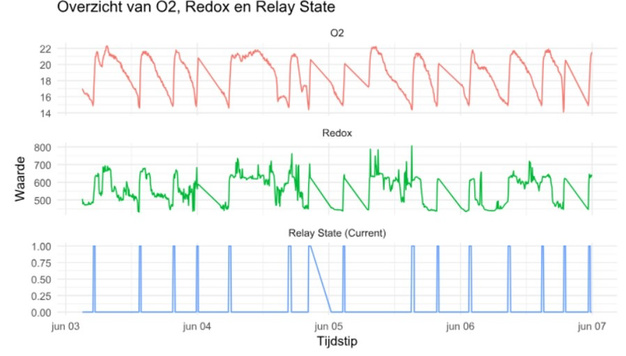
The WQU is equipped with three relays for activating alarms or opening and closing valves. The parameters and threshold values that trigger each relay can be configured in the cloud-based portal.
When the oxygen concentration decreases (red line in the graph above) and the redox value reaches a predefined critical threshold (green line), the system generates a signal to initiate a predefined action, such as opening a valve to flush the pipelines (blue line).
During this process, the Water Quality Unit continuously monitors the water quality. Immediately after flushing, the measurements show that the water quality returns to its original level, after which the flushing process is automatically stopped.
When the critical threshold is reached again, the process is repeated automatically. In this way, the water quality is continuously monitored and maintained within the predefined quality limits.
For more information:
Sendot
[email protected]
www.sendot.nl
Trending Products

Benchmark Bouquets – Flowerin...

Perfectione Roses Preserved Flowers...

Sen Flora Preserved Flowers Bouquet...

CKLMMCZX Preserved Flowers Bouquet ...

KaBloom The Romantic Classic Red Ro...
lovenfold Flowers for Delivery Prim...

Stargazer Barn – Holiday Chee...

Benchmark Bouquets – Signatur...

Bloom’s Diary Preserved Flowe...
