
“Thrips can cause significant damage and yield losses either by direct damage, such as feeding marks on the crop, or by indirect damage through acting as a virus vector, spreading viruses from one plant to the next,” says Emile de Groot, product innovation & technical development manager at Koppert South Africa. “Most crops in general will be affected by thrips either directly damaging leaves, flowers and fruit or carrying over viruses.”
An inexpensive option within easy reach of vegetable growers is the humble sweet alyssum or Lobularia maritima, itself an edible member of the Brassicaceae family. “The use of Lobularia in integrated pest management (IPM) programmes locally is very new and not often seen,” De Groot remarks. “However, in Europe it is much more of a common practice.”
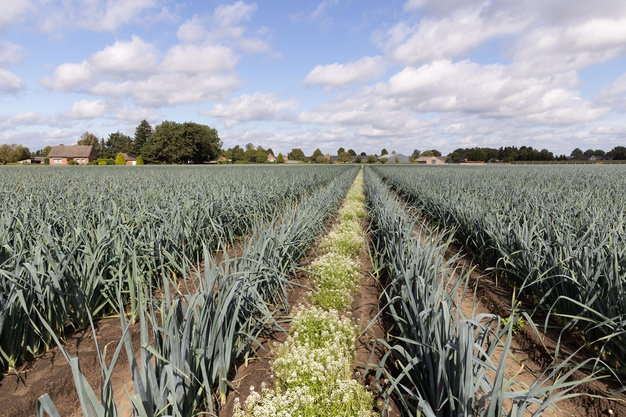
Native to southern Europe, Lobularia maritima is an indispensable part of the biodiversity seed packages used to establish hedges flowering for extended periods in Portugal and Spain. The flower provides insects with both nectar and pollen.
© KoppertLobularia maritima in a Spanish leek field
Koppert South Africa trialled the white variety of sweet alyssum on a lettuce block under shade net in the Western Cape. “Very little to no beneficial insects were found on the lettuce crop before introducing the Lobularia,” De Groot observes. “The introduction of Lobularia attracted parasitic wasps, predatory beetles, and general predators such as predatory thrips, lacewings, and hoverflies.”
Based on the successful outcome, Koppert South Africa will repeat this combination again this season. De Groot and his colleagues are also studying the use of South African indigenous flowers in vegetable production.
Karla-Mart Fullard, business innovation and technical support at Koppert, adds: “This approach also creates an opportunity to manage thrips populations directly on the Lobularia using our biological controls such as Thripor or Swirski. If populations increase excessively, targeted chemical knockdown applications can be made on the Lobularia rather than the crop itself. This may reduce the number of chemical applications required on the crop while improving overall thrips control effectiveness.”
 © Koppert
On onions, their colleagues at Koppert Spain have introduced Lobularia along with thrips predator Thripor (Orius sp.) and a beneficial nematode marketed as Entonem (Steinernema feltiae), planted around the field and in between rows two to three months ahead of the new onion crop, he explains. “The Entonem soil treatment, the Thripor addition and the natural enemies present because fewer chemical thrips management products are used, all contributed to the effective control of thrips all through the season.”
Lobularia maritima also provides pollinator forage: the well-known flower is an all-rounder with many benefits to the farmer who wishes to reduce their dependence on chemical insecticides, along with reduced mechanical and chemical weed control. The flower lifts all boats: the minute Trichogramma pretiosum and the indigenous Trichogrammatoidea cryptophlebiae parasitic wasps, whose pupae are sold by Koppert as Pretiobug and Tripar C respectively, also feed on ‘heuningblommetjies’, as the flower is also called in South Africa. Increased ladybird and hoverfly populations have been reported where a programme that includes Lobularia is followed.
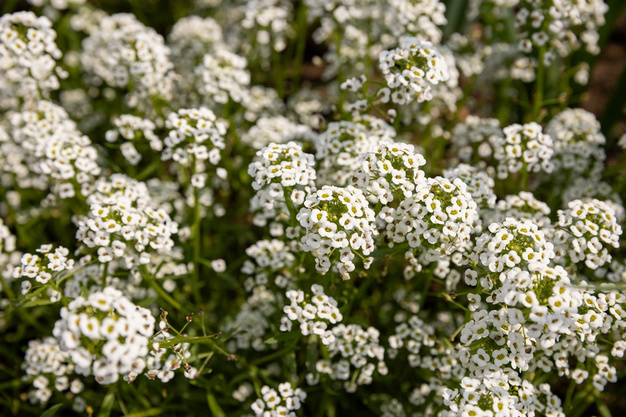 © KoppertIncreased ladybird and hoverfly populations are reported where Lobularia maritima is present
For more information:
Emile de Groot
Koppert South Africa
Tel: +27 10 020 2427
Email: [email protected]
https://www.koppert.co.za/
Trending Products

Benchmark Bouquets – Flowerin...

Perfectione Roses Preserved Flowers...

Sen Flora Preserved Flowers Bouquet...

CKLMMCZX Preserved Flowers Bouquet ...

KaBloom The Romantic Classic Red Ro...

lovenfold Flowers for Delivery Prim...

Stargazer Barn – Holiday Chee...

Benchmark Bouquets – Signatur...

Bloom’s Diary Preserved Flowe...
