
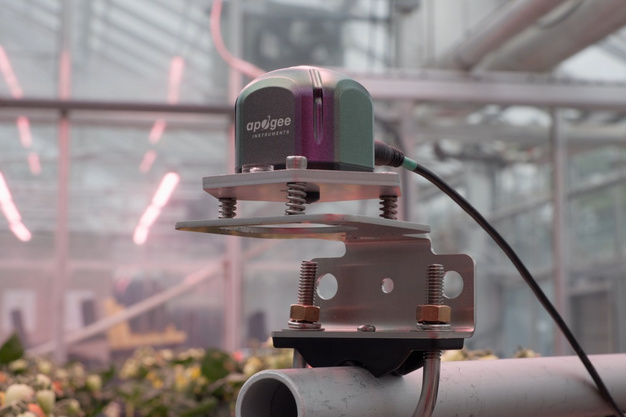
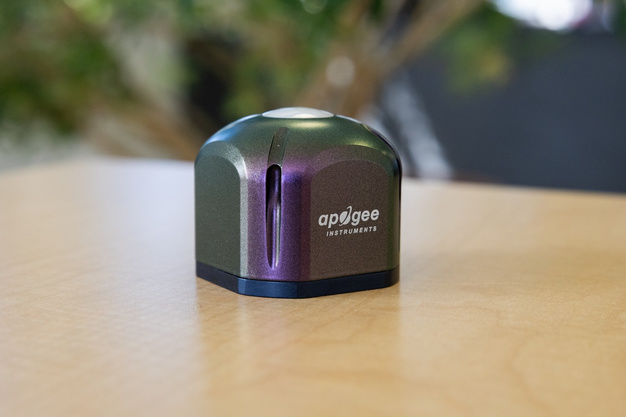
With greater control comes a greater need for accurate, continuous data. This is particularly true for LED lighting, where growers are moving beyond simply measuring light intensity and are increasingly interested in the spectrum reaching their crops. That challenge is one of the reasons Apogee Instruments developed Aurora, a permanently installed real-time spectral sensor designed to provide growers with a more detailed picture of the light environment at crop level. “Growers are no longer focused solely on total light intensity,” Jeff Struthers with Apogee Instruments explains. “They are interested in the specific spectrum of light reaching their crops.” Different crops, and even different growth stages of the same crop, can respond differently to different light recipes, making continuous spectral information increasingly valuable.
© Apogee
From light intensity to light quality
Traditional PAR sensors measure the total amount of photosynthetically active radiation, giving growers an indication of how much usable light is reaching the crop. Handheld spectroradiometers, meanwhile, can provide detailed information about the spectrum, but typically only as periodic spot measurements. Aurora is designed to bridge that gap by providing high-resolution spectral measurements continuously from 350 to 850 nm. This covers the PAR range while extending into UV-A, far-red and NIR wavelengths.
The result is a more complete picture of both the quality and quantity of light reaching the plants. Rather than relying on occasional snapshots, growers can follow changes in the light environment over time and better understand how their LED strategy translates into conditions at crop level.
 © Apogee
Supporting more precise LED strategies
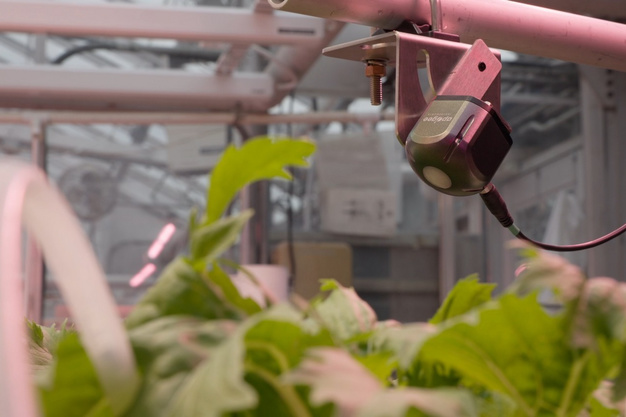
This can also support more precise lighting strategies throughout the growing cycle. “Aurora provides growers with detailed, continuous information about the spectral composition and intensity of the light their plants are receiving,” Jeff says. By measuring individual wavelengths, growers can evaluate how different parts of the spectrum may be contributing to crop performance and adjust their lighting recipes accordingly.
For example, certain wavelengths may be particularly useful during one stage of production, while their contribution may be less important later. Real-time data can help growers determine when specific wavelengths should be maintained, reduced, or potentially switched off. That creates opportunities not only to fine-tune crop quality and uniformity, but also to use supplemental lighting more efficiently.
“Having this level of real-time information can help growers optimize their use of supplemental lighting, potentially reducing energy consumption while maintaining the light conditions needed for consistent, high-quality crop production,” Jeff notes.
 © Apogee
Building the foundation for autonomous cultivation
Because Aurora is a new product, the company is still building its portfolio of commercial case studies. Apogee is currently working with growers and researchers testing the sensors in real-world greenhouse environments. “We have received positive feedback from these early users,” the company says, adding that more specific examples are expected as the trials progress.
Looking further ahead, Jeff sees this type of detailed spectral information becoming an important part of autonomous greenhouse management. Today, sophisticated environmental and spectral data is largely accessible to research institutions and highly advanced CEA operations. As the technology becomes more affordable and accessible, however, that could change.
Over the next five years, Jeff expects real-time spectral measurements to increasingly be combined with crop models, AI and automated control systems. “The goal is to move from simply monitoring the growing environment to using that information to actively optimize it.” In that sense, Aurora is not just another environmental sensor, but part of a broader move toward more precise, data-driven and eventually autonomous cultivation.
 © Apogee
Meet Apogee at GreenTech North America in booth 514
For more information: © Apogee
Apogee Instruments
Jeff Struthers
[email protected]
www.apogeeinstruments.com
721 West 1800 North Logan
UT 84321
United States of America
Trending Products

Benchmark Bouquets – Flowerin...

Perfectione Roses Preserved Flowers...

Sen Flora Preserved Flowers Bouquet...

CKLMMCZX Preserved Flowers Bouquet ...

KaBloom The Romantic Classic Red Ro...

lovenfold Flowers for Delivery Prim...

Stargazer Barn – Holiday Chee...

Benchmark Bouquets – Signatur...

Bloom’s Diary Preserved Flowe...
