
While a traditional greenhouse would move into mums and poinsettias after spring, McNitt Growers spends its fall rooting strawberry plugs for farms across the United States.
The McNitt family moved to southern Illinois in 1987 and bought a 138-acre fruit orchard. “We bought a fruit orchard that wasn’t making enough money doing fruit,” says Andy McNitt, owner of McNitt Growers in Carbondale, Illinois. “We had some spare acres that weren’t in fruit production, and we started doing vegetable production.” Vegetables carried the farm for a few years before the family built its first greenhouse. “We put up a greenhouse around ’91, and that started to consistently make money. It was something my parents were good at,” Andy says. His father had farmed barley and potatoes in Colorado and his mother had worked in a greenhouse growing bedding plants. The operation has gone from 10,000 square feet of greenhouse to around 1.4 acres.
© McNitt
Andy works alongside his brother Bill, with their parents still involved in the business. “We’ve known for a long time that he has his lane and I have mine,” Andy says. “Sometimes you need to have conversations about the other person’s lane, but you don’t need to be in it making every decision.” Bill handles plant selection and crop presentation, evaluating new varieties each season and deciding what the range carries. “When we go to Cultivate, he looks at all the new flowers and studies them. He’ll say, ‘I like this red geranium better than that red geranium because it’s better suited for the container height.'” Andy takes the equipment side. “I tend to focus more on the mechanical side of things. What equipment we need, how it’s going to work, and how it’s going to improve the process.”
Striving to be pest free
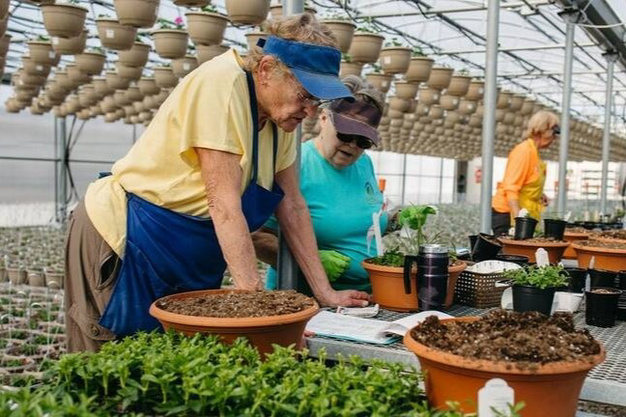
Spring fills the greenhouses with annuals, hanging baskets, planters and flats for independent garden centers, and the site opens to retail customers for the season. “We strive to be pest free,” Andy says. “And we work hard to grow plants with good shape and architecture so they really show off the blooms.” Retail buyers are left to browse the production space with staff nearby. “You can go to a box store and see maybe 50 red geraniums. Or you can come out here and see a whole lot more than that and pick the exact one you want.” The nursery added classes and greenhouse tours last year, starting with a planter class, and is expanding this season into a production tour that runs visitors through pot filling and transplanting.
 © McNitt
The strawberry route
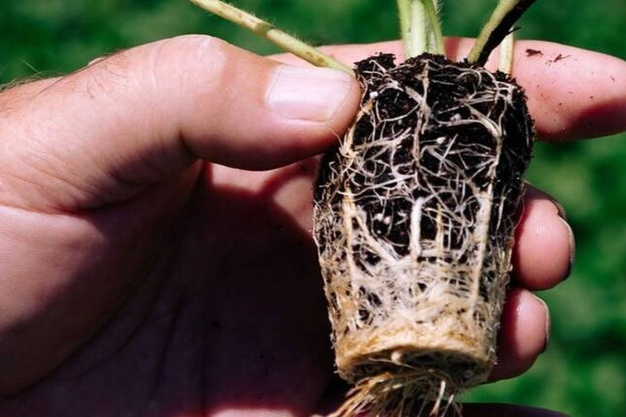
“A traditional greenhouse would grow mums and poinsettias after spring,” Andy says. “We grow strawberries instead.” Fall plug production ships to farms across the United States and begins with runners, unrooted strawberry cuttings that arrive during the summer. “I take a runner that comes out of Canada as an unrooted cutting, put it into a 50-count plug tray, and grow roots on it,” Andy says. A plug gives a strawberry grower a rooted transplant that establishes quickly in the field, which is what allows a farm to hit a fall planting window that does not move, and production is scheduled against each customer’s window. “A premium plug means a fully rooted, uniform plant with balanced top growth and zero tolerance for disease,” Andy says.
Uniform texture, moisture retention and proper aeration carry more weight in plug production, where root development is the crop being sold. McNitt Growers runs PRO-MIX BX across its production. “It gives us a baseline,” Andy says. “If it’s consistent from year to year and bale to bale, it makes my life easier.” The nursery has moved to 135-cubic-foot compressed PRO-MIX mega bales. “We’ve evolved into using the 135 compressed bales. They give me a little more time in the day because I have to feed the soil beast a lot less often,” Andy says. Handling has changed alongside the volume. “We started out filling baskets with one person and a scoop. Then we moved to a small potting machine, and eventually to a much better potting machine that lets us do it efficiently.”
 © McNitt
“It’s really cool to see the friendships and connections we’ve built across the industry,” Andy says. “When you go to something like Cultivate, you run into nothing but friendly people. There are always problems that come up. When you know the people you’re working with, you can have a real conversation and solve the problem quicker. People buy from people. “I hope people say we treated them fairly, offered a good product, and built great relationships with our customers and suppliers.”
For more information: Premier Tech Growers and Consumers
www.premiertech.com
Trending Products

Benchmark Bouquets – Flowerin...

Perfectione Roses Preserved Flowers...

Sen Flora Preserved Flowers Bouquet...

CKLMMCZX Preserved Flowers Bouquet ...

KaBloom The Romantic Classic Red Ro...

lovenfold Flowers for Delivery Prim...

Stargazer Barn – Holiday Chee...

Benchmark Bouquets – Signatur...

Bloom’s Diary Preserved Flowe...
