
At an afternoon event held at World Horti Center in Naaldwijk, the Netherlands, participants explored the latest developments and emerging business opportunities in vertical farming, a sector that has gone from niche concept to investment hype, and more recently through a wave of high-profile bankruptcies. The event, organised by the partners of Fieldlab Vertical Farming, offered a grounded look at where the sector stands today and where viable opportunities remain.
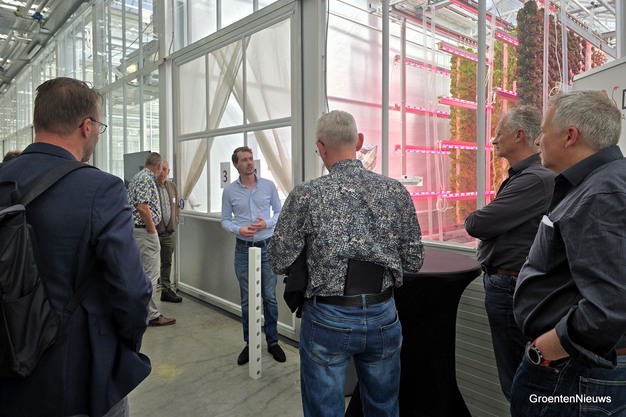
© Thijmen Tiersma | FloralDaily.comJan van den Ende of Vertify speaking with several participants in the climate cell at the I-Grow Pavilion in the World Horti Center
The Fieldlab Vertical Farming partnership brings together Delphy Improvement Centre, Greenport West-Holland, Growy, Inholland University of Applied Sciences, Logiqs, Own Greens, Signify, Vertify, and Wageningen University & Research. Several partners presented during the afternoon and took part in a facility tour.
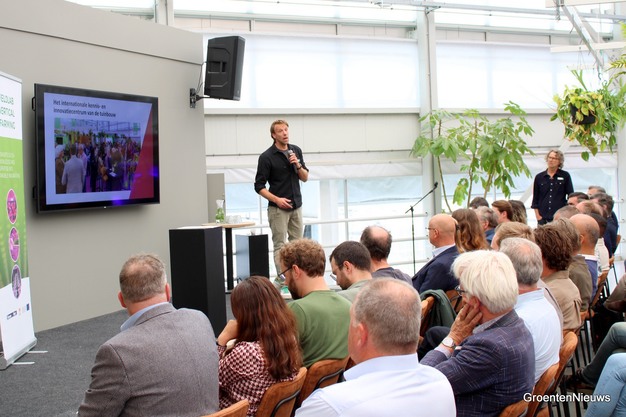 © Thijmen Tiersma | FloralDaily.com
Jim Koop (World Horti Center) explains that the I-Grow Pavilion, which started in 2020, will be redesigned this year. He invited companies to join and invest in telling the new story of vertical farming through the pavilion.
Hybrid growing as a potential breakthrough
Judith van Heck, project leader of Fieldlab Vertical Farming Zuid-Holland, opened the event by reflecting on the difficult period the sector has experienced. She noted that a more realistic outlook has taken hold: there is now greater focus on what is economically viable. In the Dutch context, Van Heck sees vertical farming as a complement to greenhouse horticulture rather than a replacement. She suggested that hybrid growing, combining vertical farming with greenhouse production, could prove to be the approach that allows the sector to genuinely scale.
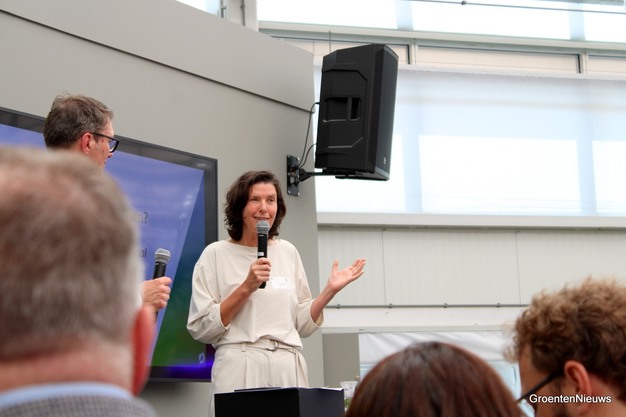 © Thijmen Tiersma | FloralDaily.com
Judith van Heck has been project leader of the Fieldlab Vertical Farming since November 2022
Calculating business cases
Coert Bregman of Wageningen Social & Economic Research addressed the financial side of vertical farming. He presented an economic model designed to help growers assess what is viable by entering a range of variables. Bregman was straightforward: growing leafy vegetables in Dutch vertical farms is difficult, though not impossible. Competition from greenhouse and open-field production is strong, and energy remains a significant challenge.
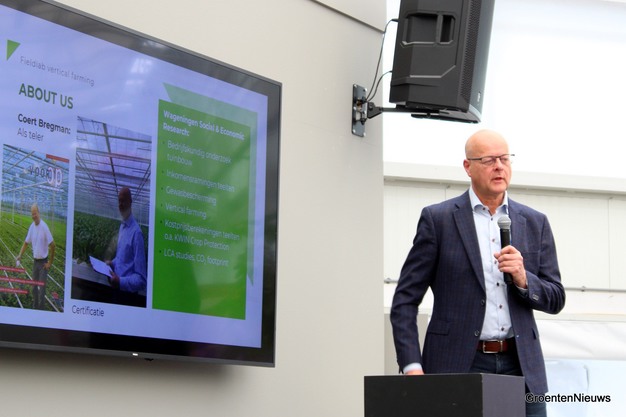 © Thijmen Tiersma | FloralDaily.com
Coert Bregman (WUR) notes that Dutch horticulture has ‘finally’ really started working with the vertical farming concept to see what is possible. Carefully calculating business cases is an important step in this. A specially developed calculation model helps with this.
Opportunities for propagation
High-value crops and propagation — particularly of planting material for ornamental horticulture — are increasingly seen as viable applications for vertical farming. Climate chambers for multi-layer propagation are already appearing at ornamental nurseries in the region, where growers are gaining hands-on experience.
Research continues on multiple fronts. Caterina Carpineti presented Wageningen UR research into a new growing system for Freesia. Trials in climate chambers in Bleiswijk have already demonstrated that the crop’s production cycle can be accelerated.
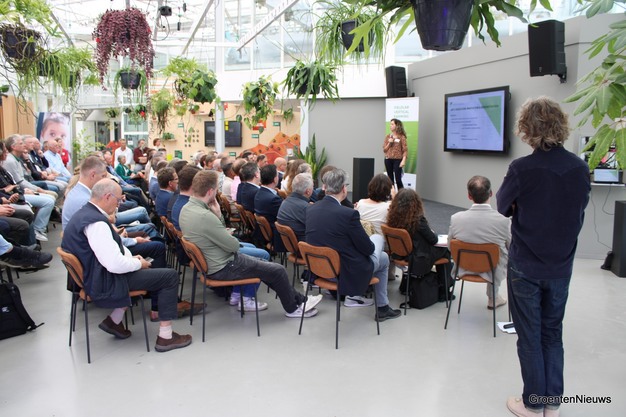 © Thijmen Tiersma | FloralDaily.com
Caterina Carpineti (WUR) speaks about the Freesia 2.0 project
Research into herb cultivation
Jarno Mooren, Plant Specialist Vertical Farming at Signify, focused on herb cultivation, presenting research into basil and oregano. A notable finding from the basil research was that identical climate settings across four different systems at four Fieldlab partner locations yielded different results. His conclusion: directly copying a crop recipe from one vertical farm to another is not advisable.
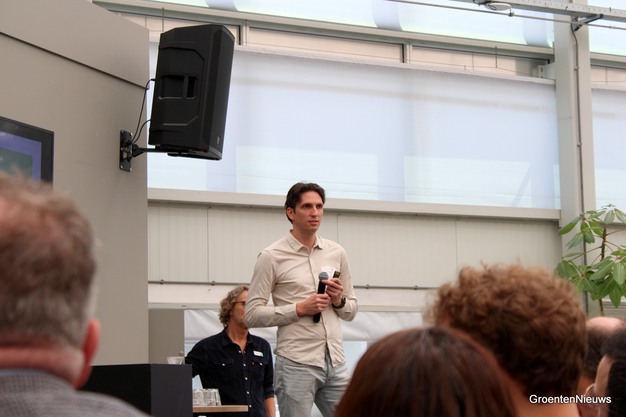 © Thijmen Tiersma | FloralDaily.comJarno Mooren (Signify) shares results from research into growing herbs in vertical farms.
For oregano, research focused on light recipes, following a practical question from Growy. Achieving the woody texture that consumers expect proved difficult, despite extensive adjustment of LED settings.
 © Thijmen Tiersma | FloralDaily.com
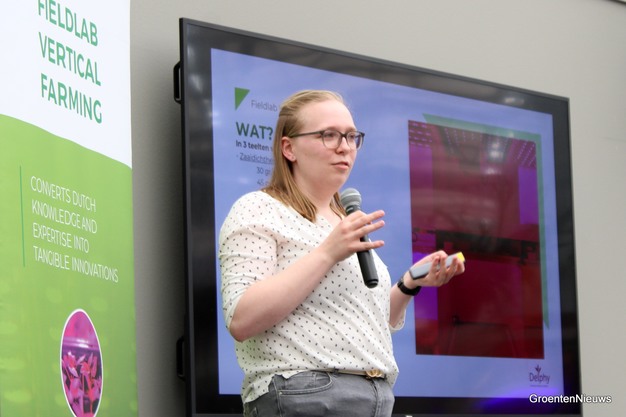
Brigit den Bakker (Delphy) takes the audience through the remarkable cultivation of grass in a vertical farm
Grass cultivation: An emerging idea
Brigit den Bakker from Delphy presented research into growing grass in a vertical farm, an idea that attracted considerable attention in the Dutch agricultural press. The concept originated with cheese producer Wouter Slob, who wants to grow fodder grass for his dairy cows indoors, freeing up his fields for walnut trees. The model would support both vegan and conventional cheese production from the same farm.
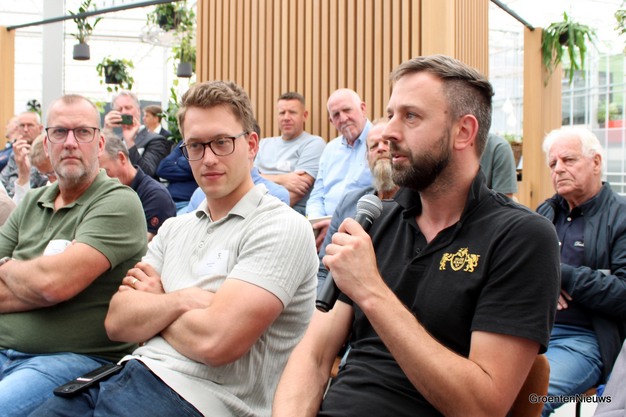
The presentation prompted questions and knowledge-sharing. One participant noted that major agricultural companies are also exploring the vertical farming of wheat, with the goal of optimising protein content under fully controlled conditions, something not achievable in outdoor cultivation.
 © Thijmen Tiersma | FloralDaily.com
The man behind the project on growing grass in a vertical farm was also present. Here cheesemaker Wouter Slob answers one of the many questions from the audience.
Growy shows it can be done
Dutch vertical farming company Growy has attracted attention, and some scepticism, for its claim to grow lettuce and herbs profitably in Amsterdam. The company is making a compelling case: it has significantly scaled its operations and now supplies more than 500 supermarkets and a similar number of restaurants across the Netherlands and Belgium.
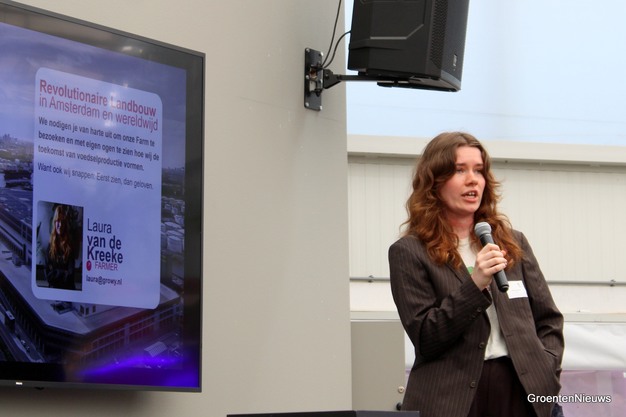
Laura, who co-founded Growy with her father Ard, traced the company’s origins. A decade ago, the family were arable farmers in the Dutch province of Zeeland. To grow speciality lettuce varieties, they built their own vertical farm, progressing rapidly from basic wooden racking to a more professional system. When the opportunity arose to take over an existing Amsterdam facility from a company that had ceased operations, they moved quickly.
 © Thijmen Tiersma | FloralDaily.com
Laura van der Kreeke invites people to come and have a look in Amsterdam and to buy and taste their products at Jumbo.
Growy now operates 48 climate chambers in Amsterdam’s port area, growing 63 crop varieties using largely proprietary technology. During the growing cycle, plants are automatically moved four times to different growth stages, each with tailored climate settings. Laura, who describes herself as “a lazy farmer who runs the business from behind a laptop,” monitors the process using smart systems.
The company has since acquired its former substrate supplier to secure its specialised growing medium, and has set up its own breeding programme in partnership with a US company. For Laura, this reflects a broader reality: the vertical farming sector has not yet matured to the point where commercially ready growers have easy access to all the inputs they need. Major breeding companies, for instance, have not yet developed substantial vertical farming assortments, something Laura understands, given that the sector is still developing. Growy, she suggests, is simply moving ahead of the curve.
 © Thijmen Tiersma | FloralDaily.comVincent van der Gaag (Dutch Lion) shows his vertical lettuce cultivation during the tour.
 © Thijmen Tiersma | FloralDaily.com
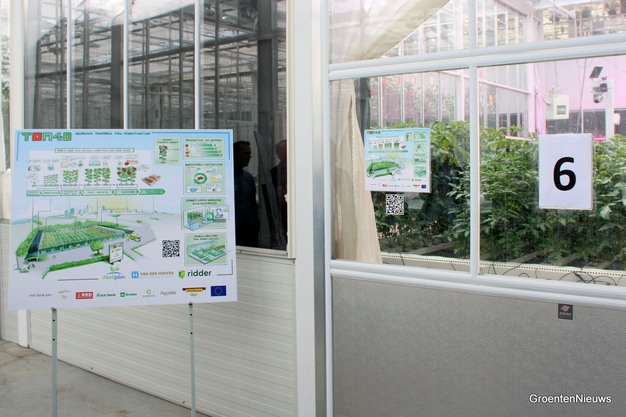
The demo with the Tom 4.0 project was also one of the stops. Here Wouter Oltheten, on behalf of Ridder Group, gave commentary and explanation about the tomato cultivation, which in terms of cultivation system closely resembles growing lettuce on water.
Trending Products

Benchmark Bouquets – Flowerin...

Perfectione Roses Preserved Flowers...

Sen Flora Preserved Flowers Bouquet...

CKLMMCZX Preserved Flowers Bouquet ...

KaBloom The Romantic Classic Red Ro...

lovenfold Flowers for Delivery Prim...

Stargazer Barn – Holiday Chee...

Benchmark Bouquets – Signatur...

Bloom’s Diary Preserved Flowe...
