
Increasing public scrutiny has raised questions about whether the use of peat is environmentally sustainable. A new review by Dr. James Altland, Research Leader at the USDA Agricultural Research Service, and Dr. Bruce Bugbee of Utah State University argues that current evidence presents a more nuanced picture than is often portrayed.
“Much of the discussion in the popular press suggests that use of peat in horticulture is unsustainable as it contributes to global warming and other environmental impacts,” James shares. “We found peat is a lot more sustainable than what some factions of the media would have us believe.”
© USDA
Regional differences matter
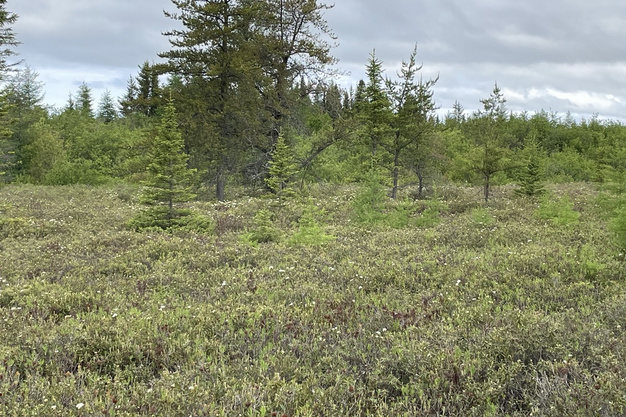
The review argues that assessments of peat sustainability should distinguish between regions. While European peatlands have been heavily affected by centuries of drainage and peat extraction, most Canadian peatlands remain undisturbed, with only a small proportion used for horticultural harvesting. According to the authors, this distinction is important when evaluating the environmental impact of peat production.
“Canadian peatlands are currently accumulating carbon faster than the rate of extraction for containerized crop production. At current extraction rates and with proper restoration, North American peat use is environmentally sustainable.”
The authors note that horticultural peat extraction in Canada occupies only a small fraction of total peatland area and that harvested sites are routinely restored after production.
 © USDA
Restoration supports long-term recovery
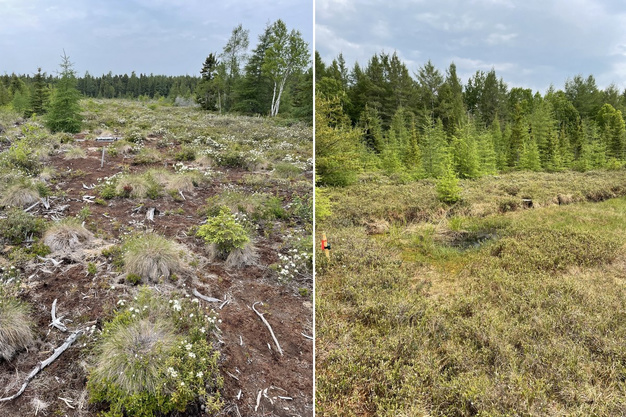
The paper highlights the role of restoration practices, particularly the Moss Layer Transfer Technique (MLTT), in re-establishing peat-forming ecosystems.
“Restoration techniques, such as the moss layer transfer technique, can return harvested peatlands to carbon sinks within decades,” he adds. According to the review, restored peatlands can recover vegetation, biodiversity and carbon sequestration functions over time, while improvements in water storage and hydrological performance have also been documented.
 © USDA
Alternatives also have environmental impacts
The researchers also examined published life cycle assessments comparing peat with substrates including coir, wood fibre, perlite and rock wool. “Life cycle assessments show that alternative substrates often have environmental impacts equal to or greater than peat, especially when considering water use, transport and fertilizer inputs.”
The review concludes that comparisons depend heavily on system boundaries and assumptions, and that broad claims that alternatives are inherently more sustainable than peat are not consistently supported by published analyses.
 © USDA
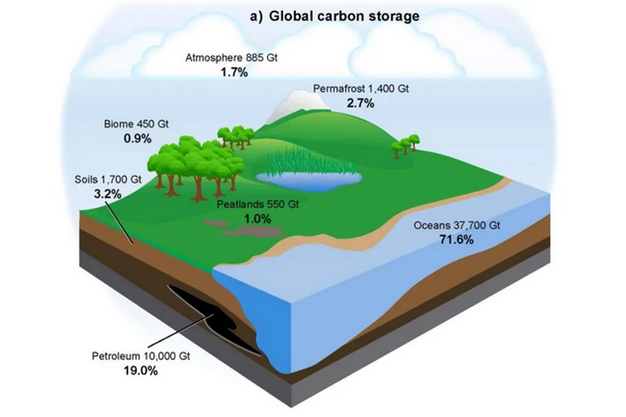
Figure A: Global storage of carbon in natural systems (Gt, gigatons)
(Hirschler and Osterburg, 2022; Cleary et al, 2005; IPCC, 2023)
Performance remains an important consideration
Beyond sustainability, the paper reviews the functional characteristics that have made peat the benchmark substrate for container production.
“Peat’s high cation exchange capacity, water retention and stability support optimal plant growth and nutrient uptake,” James shares. The authors note that these properties contribute to efficient irrigation and fertiliser management while maintaining favourable root-zone conditions.
Although wood fibre, coir and other materials can reduce peat use in blends, each introduces its own management considerations, such as nutrient immobilisation, water use or processing requirements.
 © USDA
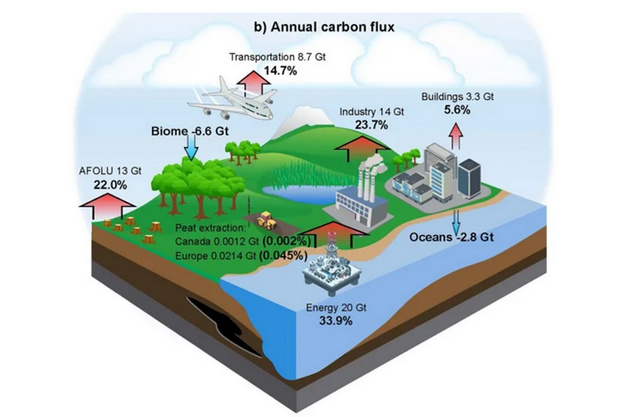
Figure B: Annual flux of carbon from human activities and sequestration by natural processes (Gt CO2-eq per year)
(Hirschler and Osterburg, 2022; Cleary et al, 2005; IPCC, 2023)
Managing future demand
With global demand for soilless growing media expected to increase substantially over the coming decades, the authors believe multiple substrate materials will be needed.
“At current extraction rates and with proper restoration, North American peat use is environmentally sustainable and remains essential for horticultural production and urban greening.”
For more information:
U.S. Department of Agriculture
James Altland, Research Leader
Application Technology Research Unit
[email protected]
www.usda.gov
Trending Products

Benchmark Bouquets – Flowerin...

Perfectione Roses Preserved Flowers...

Sen Flora Preserved Flowers Bouquet...

CKLMMCZX Preserved Flowers Bouquet ...

KaBloom The Romantic Classic Red Ro...
lovenfold Flowers for Delivery Prim...

Stargazer Barn – Holiday Chee...

Benchmark Bouquets – Signatur...

Bloom’s Diary Preserved Flowe...
