
Behind a major development for Colombia’s flower industry lies years of scientific research, technical expertise, and coordinated efforts to improve market access for Colombian chrysanthemums.
Last week, the U.S. Department of Agriculture’s Animal and Plant Health Inspection Service (APHIS) announced the removal of chrysanthemum white rust from its list of quarantine pests, effective November 9, 2026. The decision opens the door to simpler export procedures, potential annual savings of up to US$6 million for Colombian growers, and new commercial opportunities in the U.S. market.
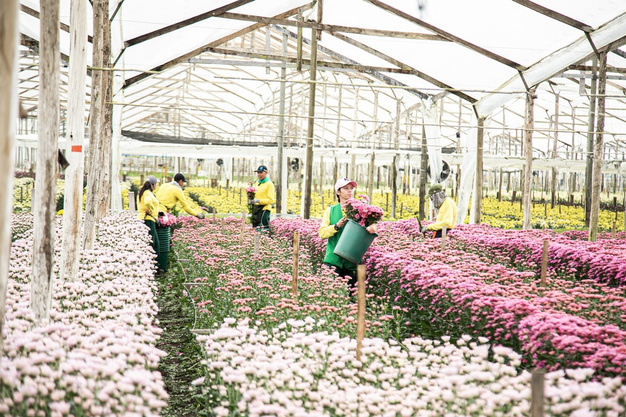
For Colombia, the world’s leading supplier of chrysanthemums to the United States, the implications are significant. In 2025, Colombian flowers accounted for approximately 98.6% of U.S. chrysanthemum imports, representing nearly US$143 million in export value and 31,803 metric tons.
© Asocolflores
The scientific and technical work behind the decision
The recent announcement follows years of sustained efforts by the Association of Colombian Flower Exporters (Asocolflores) and its innovation center, Ceniflores, working alongside scientific institutions, phytosanitary authorities, and strategic partners.
Since 2022, Ceniflores, together with Universidad Católica de Oriente, has conducted research into the biology and behavior of chrysanthemum white rust under Colombia’s tropical growing conditions. This research generated scientific evidence that contributed to the phytosanitary risk assessment process and supported the review of regulatory requirements based on the actual conditions of Colombian flower production.
Beyond scientific research, Asocolflores and Ceniflores actively participated in APHIS public consultations, maintained close coordination with the Colombian Agricultural Institute (ICA), and, with the support of Araujo Ibarra, engaged with more than 30 stakeholders and strategic partners.
 © Asocolflores
These efforts, together with cooperation between the Colombian government and U.S. authorities, demonstrate how scientific evidence, sustained industry representation, and phytosanitary diplomacy can contribute to overcoming trade barriers.
What comes next: Turning regulatory progress into tangible benefits
Although the APHIS decision represents an important milestone, the work is far from over. The next phase will focus on ensuring that Colombia’s regulatory framework and export procedures reflect the new U.S. requirements.
Asocolflores and Ceniflores will continue working closely with ICA and the Colombian government to support the necessary regulatory adjustments and facilitate the implementation of simplified export procedures.
The decision also creates opportunities to expand exports of chrysanthemum propagation material to the United States, including cuttings, stems and leaves intended for propagation, as well as plants and plantlets produced through in vitro cultivation.
Realizing these opportunities will require further technical work to define and implement the applicable phytosanitary protocols under a systems approach, while maintaining appropriate prevention, monitoring, and disease management measures.
 © Asocolflores
“This decision shows what can be achieved through years of scientific research, technical expertise, and collaboration between the private sector and public authorities. But our work does not end here. Our priority now is to work closely with the Colombian government and phytosanitary authorities to ensure these regulatory changes translate into tangible benefits for our growers, stronger competitiveness, and new opportunities in the U.S. market,” said Laura Valdivieso, Executive President of Asocolflores.
A significant opportunity for Colombia’s flower industry
For Colombia’s approximately 1,368 hectares of chrysanthemum production, the elimination of specific phytosanitary requirements associated with chrysanthemum white rust could generate savings of up to US$6 million annually once the corresponding regulatory adjustments are implemented. These potential savings would come from reducing compliance costs and simplifying procedures that have historically affected chrysanthemum exports.
At a time when Colombian flower growers face increasing production costs, exchange-rate fluctuations, and challenging international trade conditions, improvements in market access and operating efficiency are especially valuable.
Beyond the immediate economic implications, this development reinforces Colombia’s position as the leading supplier of chrysanthemums to the United States and highlights the importance of investing in scientific research and long-term industry collaboration.
For Asocolflores and Ceniflores, the priority is now to translate this regulatory milestone into tangible benefits for Colombian growers and exporters.
For more information:
Asocolflores
https://asocolflores.org/
Trending Products

Benchmark Bouquets – Flowerin...

Perfectione Roses Preserved Flowers...

Sen Flora Preserved Flowers Bouquet...

CKLMMCZX Preserved Flowers Bouquet ...

KaBloom The Romantic Classic Red Ro...

lovenfold Flowers for Delivery Prim...

Stargazer Barn – Holiday Chee...

Benchmark Bouquets – Signatur...

Bloom’s Diary Preserved Flowe...
