
A new report from Dutch consultancy BlueTerra, the WKK Barometer 2026, shows that gas-engine combined heat and power (CHP) installations will continue to play a significant role in the Netherlands’ horticulture sector through 2030 and 2035. The analysis indicates that CHP units will be needed for longer and more frequently than previously anticipated, partly because growth in renewable electricity production is lagging behind earlier projections.
Greater need for controllable capacity
According to the barometer, grid-supplying CHP units are expected to run around 3,300 full-load hours in 2030, dropping only slightly to roughly 2,700 full-load hours by 2035. Operating hours are higher for CHP units serving lit crops, since part of the electricity generated is used directly by the grower.
The main driver behind these figures is that the expansion of wind and solar energy is proceeding more slowly than expected, while electricity demand continues to rise. As a result, there remains a need for dispatchable capacity at times of low solar and wind output, high demand, or limited import capacity.
Increasing tension between sustainability and security of supply
These findings align with grid operator TenneT’s Monitor Voorzieningszekerheid 2026 (Security of Supply Monitor), which warns that risks to electricity supply will increase from 2030 onward and recommends introducing a capacity mechanism.
The WKK Barometer underscores this continued role for CHP. Installed CHP capacity in Dutch horticulture grew again in 2025, adding a net 65 MWe. At the same time, little new dispatchable capacity is expected to come online before 2030, and lead times for new CHP installations have now stretched beyond three years. Retaining existing capacity is therefore becoming increasingly important, both for growers and for the wider energy system.
This creates a tension: horticulture must continue cutting CO2 emissions, while the electricity system still needs dispatchable capacity for the time being. CHP units can fill that role, since they can ramp up and down quickly while also supplying heat and CO2 to the greenhouse.
Policy decisive for economic viability
The economic case for CHP will depend heavily on future policy. Measures such as the phase-out of tax benefits, the domestic CO2 levy, the EU’s ETS2 emissions trading scheme, and a possible green gas blending mandate could all raise the cost of gas-fired CHP operation.
Under the government’s scenario that includes compensation, the barometer’s outlook remains favorable through 2030, with the report’s Figure 1-1 illustrating the effect on payback periods. Beyond 2030, however, it remains uncertain how compensation schemes will develop, so projections for that period are based on modeling assumptions rather than confirmed policy.
© BlueTerra
Figure 1-1: Barometer readings for the national scenario ETS2 + blending obligation with compensation. Green means a payback period of less than 5 years.
Under the alternative scenario without compensation, the additional costs of ETS2 and the blending mandate would be passed on in full to the sector. In that case, the economic outlook deteriorates sharply, both for grid-supplying installations and for on-site consumption, as shown in Figure 1-2.
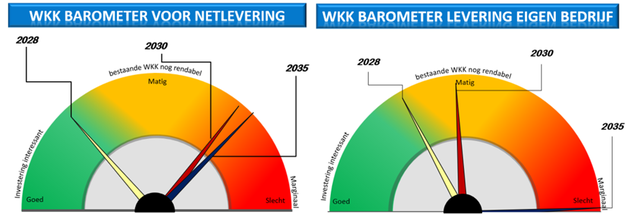 © BlueTerra
Figure 1‑2: Barometer readings for the national scenario ETS2 + blending obligation without compensation. Barometer color legend: green = payback period < 5 years, orange = 5 to 8 years, red = ≥ 9 years.
This highlights how central compensation policy is to the future availability of CHP capacity. If costs are not properly aligned with the market value of CHP, the merit order could be disrupted. That would not only reduce operating hours but also make those hours less predictable, making it harder for growers to justify investment, maintenance, and reinvestment decisions. Over time, this could lead to a shrinking CHP fleet.
For growers, smart control is therefore becoming increasingly important. By combining CHP with heat buffers, supplemental lighting, batteries, and real-time grid data, growers can make better use of available flexibility and create value for both their business and the broader electricity system, without adding unnecessary grid congestion.
CHP as a system component
BlueTerra’s core message in the WKK Barometer is clear: in the coming years, CHP will function not only as a business asset but as a component of the wider energy system. For policymakers, this means emissions reduction and the preservation of dispatchable capacity need to be considered together. As long as the electricity system continues to rely on CHP capacity, clarity is needed on tax burdens, carbon costs, compensation mechanisms, and possible participation in a future capacity market.
For more information:
BlueTerra 
[email protected]
https://www.blueterra.nl/
Trending Products

Benchmark Bouquets – Flowerin...

Perfectione Roses Preserved Flowers...

Sen Flora Preserved Flowers Bouquet...

CKLMMCZX Preserved Flowers Bouquet ...

KaBloom The Romantic Classic Red Ro...

lovenfold Flowers for Delivery Prim...

Stargazer Barn – Holiday Chee...

Benchmark Bouquets – Signatur...

Bloom’s Diary Preserved Flowe...
