
Japanese boxwoods (Buxus microphylla japonica) are among the most widely grown nursery crops, but they carry a well-known vulnerability: soilborne pathogens. In hot, humid summers, diseases including Phytophthora, Pythium, Fusarium, Rhizoctonia, Cylindrocladium, and Thielaviopsis can devastate production, driving up costs and undermining crop consistency.
BioWorks recently conducted a trial to evaluate whether RootShield PLUS+ G, a biological fungicide combining Trichoderma harzianum strain T-22 and Trichoderma virens strain G-41, could outperform standard chemical fungicide rotations. The trial involved 208 potted boxwoods in a high-pressure environment where 80% of plants in the previous crop had shown disease symptoms. The product was incorporated into the potting media at canning (3 lbs/yd³), with no additional fungicides applied during the trial period.
Disease incidence and root development
Results were striking. Plants treated with RootShield PLUS+ G showed a disease incidence of just 0.96%, two out of 208 plants, with roots described as bright white, vigorous, and abundant. In contrast, Control 1 (standard fungicide spray rotation) recorded 60% disease incidence, while the untreated Control 3 showed 15% incidence with thin roots that failed to fill the pot. Control 2, also on a standard spray rotation, saw minimal losses, though this was attributed to better drainage in that section of the nursery rather than fungicide performance.
© BioWorks Inc.RootShield® PLUS+ G on left and Control 3 on right
Root mass data reinforced the results. Plants treated with RootShield PLUS+ G averaged 445 g dry root weight, compared to 189 g (Control 1), 306 g (Control 2), and 212 g (Control 3). The treated plants showed dense, white roots with full container fill, a clear indicator of both plant health and marketable quality.
Cost efficiency
The economics are equally compelling. RootShield PLUS+ G cost approximately $30 per 100 pots as a single application at canning, while the standard fungicide rotations in Controls 1 and 2 ran $46–$54 per application per 100 pots, and required repeated applications throughout the growing season. The untreated control carried no direct input cost, but the downstream risk of a 15% or higher loss rate tells its own story.
By replacing six to eight chemical products with a single biofungicide, growers can reduce disease management costs by roughly 35–45% while dramatically cutting labour and application complexity. There is also no risk of fungicide resistance developing, a growing concern with repeated chemical rotations.
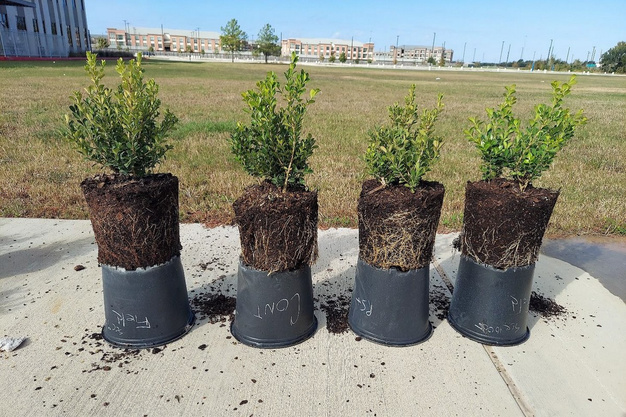 © BioWorks Inc.Comparison of all four groups in the trial. From left to right: Control 1, Control 3, RootShield Plus G, and Control 2.
Operational advantage
Applied once at canning, RootShield PLUS+ G eliminates the scheduling, labour, and variability that come with managing multiple spray programmes. In a high-pressure trial environment, it delivered near-complete disease suppression, a result that standard rotations failed to match.
For nursery producers looking to improve consistency, reduce input costs, and protect crop value, RootShield PLUS+ G represents a straightforward and high-return addition to the production programme.
For more information:
BioWorks
https://bioworksinc.com
Trending Products

Benchmark Bouquets – Flowerin...

Perfectione Roses Preserved Flowers...

Sen Flora Preserved Flowers Bouquet...

CKLMMCZX Preserved Flowers Bouquet ...

KaBloom The Romantic Classic Red Ro...
lovenfold Flowers for Delivery Prim...

Stargazer Barn – Holiday Chee...

Benchmark Bouquets – Signatur...

Bloom’s Diary Preserved Flowe...
