
A biocontrol agent arriving alive is not equal to a biocontrol agent arriving and continuing to perform. In biocontrol, focus is often rightly given to release rates, species selection, and timing – but another important factor influencing the long-term success of your biocontrol program, humidity, may slip between the cracks.
Predatory mite sachets are often marketed as a “set-it-and-forget-it” solution for many pest management problems in greenhouses, but their success often depends on something far less visible: microclimate. Inside each sachet is a small, self-contained ecosystem where humidity levels and airflow determine whether the program succeeds or fails. Years of research are behind the formula for the big job this mini-ecosystem performs. The success is in the small details.
Biocontrol agents continue to respire, develop, and reproduce during transit and storage. This makes them highly dependent on relative humidity and temperature stability.
Arthropods lose water continuously through their cuticle, so small-bodied organisms (like mites) have a high susceptibility to desiccation because of their surface-area-to-volume ratio. Eggs and immature stages are often the most vulnerable.
This means that packaging is not simply a container to get your biocontrol onto your crop – it is part of the biological system itself. When it comes to building a lasting biocontrol program, ensuring the biocontrol agents have their ideal ‘home’, ensures your investments will continue as expected.
Sachets are a commonly used, slow-release biocontrol system. They contain a predatory mite species to be released (e.g., Amblyseius swirskii, Neoseiulus cucumeris), a factitious prey “feeder mite” to act as a food source, and a substrate to provide protection and food for the feeder mite population. Reproduction within the sachet promotes extended release of the biocontrol agent, which provides sustained control of pest populations.
The microclimate inside the sachet is integral for the sachet’s success. Relative humidity is the most important factor to maintain and monitor. If the internal humidity drops, the food source for the feeder mites disappears, effectively collapsing the internal food chain. Additionally, predatory mites require enough humidity to keep their eggs viable. Low humidity means no food for feeder mites, plus desiccation to both mite species’ eggs. All this results in a collapsed population and an empty sachet.
© Global Horticultural Inc.
Although it may seem very small, and sometimes hard to see, the emergence hole is engineered intentionally to be just the right size for mites to emerge gradually, while maintaining an ideal microclimate within the sachet. Follow this link to an article from OnFloriculture that describes this significant, but tiny, detail.
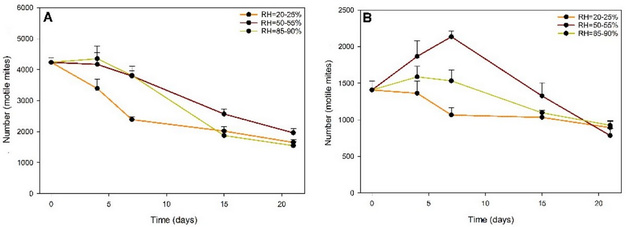 © Global Horticultural Inc.Total numbers of motile mites/sachet (means) of the prey mite Carpoglyphus lactis (A) and the predatory mite Amblyseius swirskii (B) inside slow-release sachets subjected to three levels of RH, namely, low (22.5%), medium (52.5%) and high (87.5%), in laboratory trials under controlled conditions (temperature = 25 ± 1 °C) (whiskers show the SE values). Source: https://www.mdpi.com/2223-7747/11/19/2493
The functionality of sachets has been tried and tested over the years, with humidity coming out on top as one of the most important factors for egg survival, reproduction rates, and the longevity and success of the sachet. Sachets are self-contained ecosystems that allow biocontrol agents to survive and reproduce, outputting consistent numbers of those agents onto a targeted crop. However, small changes (dry air, altered packaging, poor placement) can dramatically affect the overall performance of a biocontrol product and the results seen within a program.
In biocontrol, the smallest details – down to a pinhole – can often make all the difference.
For more information:
Global Horticultural Inc.
Tel: +1-800-668-9567
https://globalhort.com/
Trending Products

Benchmark Bouquets – Flowerin...

Perfectione Roses Preserved Flowers...

Sen Flora Preserved Flowers Bouquet...

CKLMMCZX Preserved Flowers Bouquet ...

KaBloom The Romantic Classic Red Ro...

lovenfold Flowers for Delivery Prim...

Stargazer Barn – Holiday Chee...

Benchmark Bouquets – Signatur...

Bloom’s Diary Preserved Flowe...
