
For Frank Giglia, Owner of Signature Supplies, selecting greenhouse coverings begins with understanding the crop rather than choosing a standard shade percentage. After working with growers for more than 25 years across climates ranging from the Caribbean to Alaska, he believes the covering is one of the most important decisions in greenhouse design because it determines the light, temperature, and pest environment that follows.
“Latitude, snow, local environmental conditions, temperature range, the crop and the grower’s objectives all influence the recommendation,” he says. “One size does not fit all.”
His approach always starts with the same questions: What crop is being grown? What structure is being used? What does the grower want to accomplish? Once those answers are known, the focus shifts to maximising photosynthetically active radiation (PAR), managing temperature and delivering the appropriate light spectrum for each stage of crop development.
Managing light rather than blocking it
“I think DLI (Daily Light Integral) is the most important metric and is the foundation of sunlight management.” He believes growers often underestimate how much influence greenhouse coverings have on DLI.
“Growers have been told they can’t control DLI. They think darker screens are cooler. They’re not; only darker. They think energy curtains are shade curtains. They’re heat-retention curtains.”
According to Frank, every glazing material affects the amount of usable light entering a greenhouse. Rather than focusing only on stated shade percentages, growers should consider how coverings influence DLI throughout the day, as well as the risk of light saturation.
“Too much PAR can be worse than not having enough because the plants shut down.”
© Signature Supplies
Matching the covering to the crop objective
Instead of relying on a single solution, he recommends selecting coverings according to the production goal.
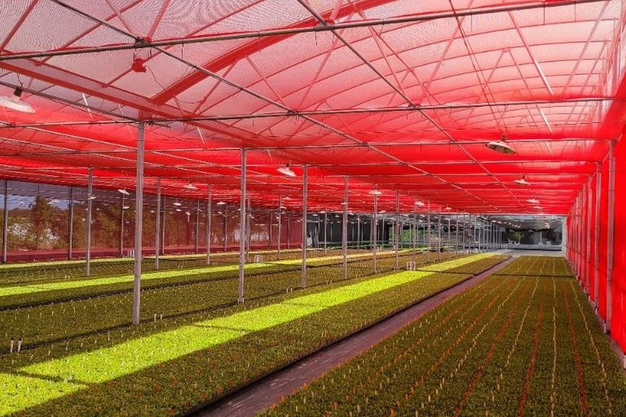
For example, he has worked with a commercial hydrangea grower that uses ChromatiNet® Red 30% to encourage earlier flowering and ChromatiNet® Blue 60% to extend late-season production, adding approximately two months to the marketing season. “We are able to do this by controlling the wavelength reaching the plants as well as the volume of sunlight.”
 © Signature Supplies
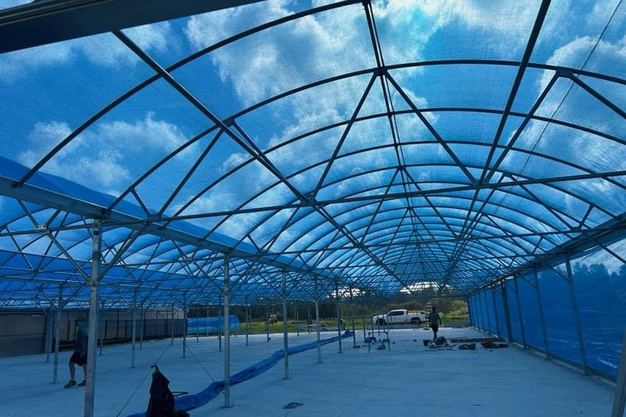
He adds that reflective coverings such as Aluminet® and photoselective materials such as ChromatiNet® help redirect and diffuse sunlight, allowing growers to improve light distribution throughout the crop while moderating temperature.
 © Signature Supplies
Combining optical and physical insect exclusion
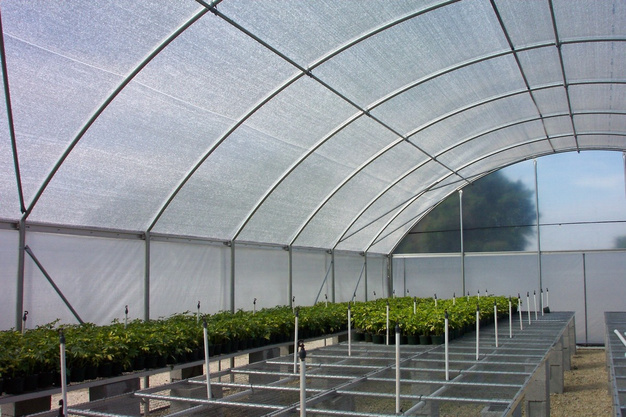
Insect management presents another challenge because conventional fine-mesh screens often restrict ventilation. According to him, optical insect screens such as OptiNet® combine physical exclusion with light-manipulating properties that reduce insect pressure while maintaining better airflow than traditional high-density screens.
“The element added into the net allows OptiNet to repel insects and maintain ambient airflow. It helps bring thrips pressure below levels associated with tighter nets that cut off airflow.”
He notes that combining roof and sidewall coverings allows different functions to work together. For example, using Aluminet® on the roof for temperature management and light diffusion, together with OptiNet® on sidewalls and vents for insect exclusion, enables growers to manage climate and pests without relying on a single material to perform multiple tasks.
 © Signature Supplies
Designing the environment before adding equipment
For Frank, greenhouse coverings should be viewed as the foundation of controlled environment agriculture rather than simply as shade products. “Coverings do everything. Your entire growing environment is built by the covering you choose. After that, you can only respond to it, for the duration of the structure.” By selecting coverings that optimise DLI, temperature, light quality and airflow, growers can reduce disease pressure, insect pressure, water use, labour and energy consumption before investing in additional environmental control systems.
“My objective is what is the best product to increase your profitability. I didn’t come here to save you money. I came here to make you money.”
He expects manufacturers to continue developing glazing materials and shade nets with reflective, diffusive and wavelength-selective properties. However, he believes future innovation should continue to prioritise maintaining DLI while improving environmental control. “The covering that best controls DLI will have the greatest impact.”
For more information:
Signature Supplies
Frank Giglia
+1 (863) 698-0399
[email protected]
www.signaturesupplyonline.com
Trending Products

Benchmark Bouquets – Flowerin...

Perfectione Roses Preserved Flowers...

Sen Flora Preserved Flowers Bouquet...

CKLMMCZX Preserved Flowers Bouquet ...

KaBloom The Romantic Classic Red Ro...
lovenfold Flowers for Delivery Prim...

Stargazer Barn – Holiday Chee...

Benchmark Bouquets – Signatur...

Bloom’s Diary Preserved Flowe...
